
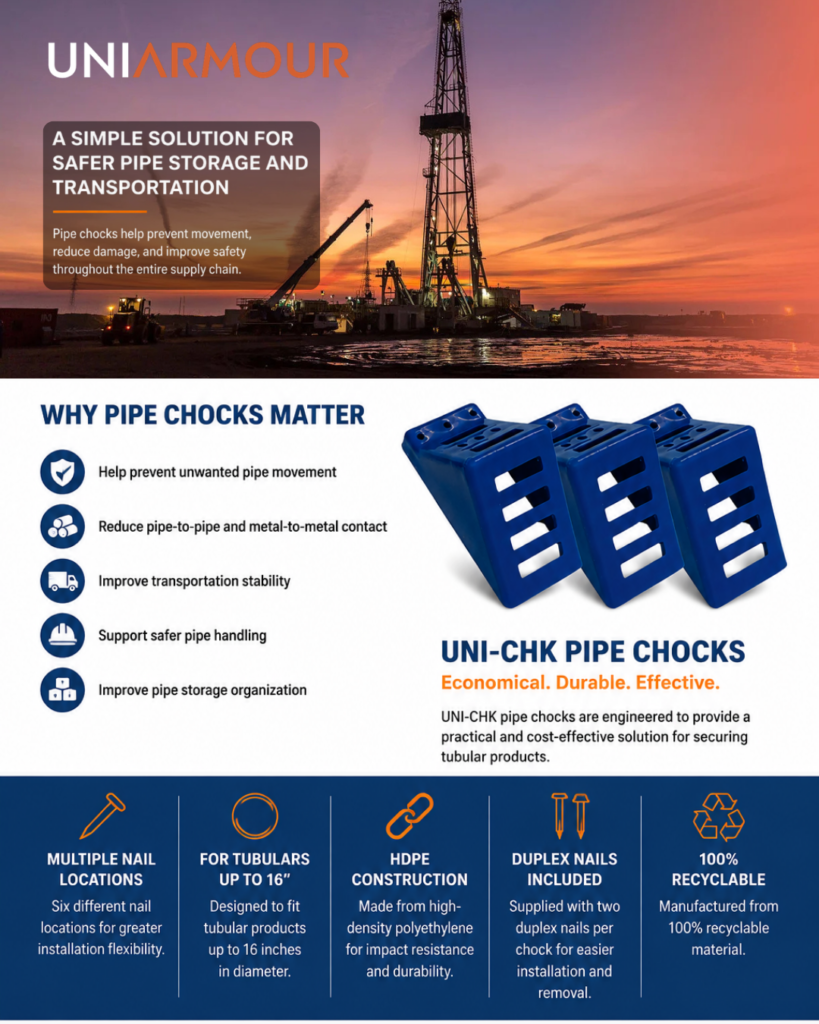
In the oil and gas industry, tubular products represent a significant investment. From manufacturing and storage to transportation and field operations, pipes must be handled carefully to prevent movement, impact damage, and unnecessary wear.
One of the simplest ways to improve pipe stability is by using pipe chocks.
Although small compared with the tubulars they support, pipe chocks play an important role in pipe storage, transportation, handling, and overall asset protection. By helping prevent unwanted pipe movement, they can contribute to safer operations while reducing the risk of costly damage.
At UniArmour, our UNI-CHK pipe chocks are engineered to provide a practical, durable, and cost-effective solution for securing tubular products.
What Are Pipe Chocks?
Pipe chocks are support devices designed to help prevent pipes and tubulars from rolling or shifting while stored or transported.
They are typically positioned alongside the pipe and secured to wooden supports or dunnage. Once installed, the chock creates a physical barrier that helps keep tubulars in position.
This simple function can make a significant difference.
Large tubular products are heavy and cylindrical by nature. Without proper stabilization, they can shift during handling, storage, loading, or transportation. This movement may result in pipe-to-pipe contact, damaged equipment, disorganized storage, or additional safety risks.
Using the right pipe chocks helps create a more stable and controlled pipe handling environment.
Why Are Pipe Chocks Important?
Proper pipe protection is about more than protecting the ends of a tubular. The entire product must remain stable throughout the supply chain.
Here are several reasons why pipe chocks are important for oil and gas operations.
1. Help Prevent Unwanted Pipe Movement
The primary function of a pipe chock is simple: keep the pipe in place.
Tubulars can roll or shift when stored on racks, wooden supports, or transportation equipment. Pipe chocks provide a physical restraint that helps maintain their intended position.
This is particularly important when managing multiple tubulars in storage yards, manufacturing facilities, warehouses, and transportation environments.
2. Reduce Pipe-to-Pipe and Metal-to-Metal Contact
Uncontrolled movement can cause tubulars to strike neighboring pipes or other equipment.
Repeated contact may result in scratches, dents, coating damage, or damage to sensitive components.
By helping stabilize individual pipes, chocks can reduce unwanted movement and the likelihood of damaging contact.
3. Improve Transportation Stability
Transportation exposes tubular products to vibration, acceleration, braking, turns, and changing road conditions.
Even when a load is properly secured in accordance with applicable procedures, minimizing movement within the load remains important.
Pipe chocks for transportation provide an additional method of maintaining pipe position and supporting a more stable load configuration.
4. Support Safer Pipe Handling
A rolling pipe presents an obvious hazard.
Because oilfield tubulars can be extremely heavy, unexpected movement can create significant risks for personnel and equipment.
Pipe chocks help maintain a more controlled storage and handling environment by reducing the possibility of unintended rolling or shifting.
They should always be used as part of the appropriate site-specific handling, loading, and load-securement procedures.
5. Improve Pipe Storage Organization
Effective pipe storage is not only about safety. Organization also matters.
Keeping tubulars properly positioned makes storage areas easier to manage and can simplify inspection, inventory management, loading, and unloading operations.
Properly positioned pipe chocks can therefore contribute to a cleaner and more efficient tubular storage system.
Pipe Chocks for OCTG Storage and Transportation
Oil Country Tubular Goods (OCTG) move through multiple environments before reaching the wellsite.
A typical tubular may pass through manufacturing facilities, storage yards, distribution centers, trucks, ports, and field locations.
At every stage, controlling movement helps protect the asset.
For this reason, OCTG pipe protection should address both connection protection and tubular stability.
Thread protectors help protect precision-machined connections from impacts and contamination, while pipe chocks help keep the tubular itself properly positioned during storage and transportation.
Together, these protection methods can help reduce preventable damage from the mill to the wellsite.
Introducing UNI-CHK Pipe Chocks
UniArmour developed UNI-CHK as an economical pipe chock solution engineered for oilfield tubular applications.
The design focuses on three important operational priorities:
- Installation flexibility
- Impact resistance
- Cost efficiency
UNI-CHK is manufactured from HDPE (high-density polyethylene), providing a durable and impact-resistant solution for demanding pipe handling environments.
Its optimized design also reduces unnecessary material while maintaining the structural performance required for the application.
Key Features of UNI-CHK
UNI-CHK has been designed to make pipe chock installation practical and flexible.
Multiple Nail Locations
UNI-CHK features six different nail locations, giving personnel greater flexibility when securing the chock to wooden supports.
This allows the installer to select the most practical fastening points depending on the specific configuration.
Designed for Tubulars up to 16 Inches
UNI-CHK can be used with tubular products up to 16 inches in diameter, making it suitable for a broad range of pipe storage and transportation applications.
HDPE Construction
The chock is manufactured from high-density polyethylene, providing impact resistance and durability while keeping the component lightweight and easy to handle.
Duplex Nails
UNI-CHK is supplied with two duplex nails per chock.
The duplex-head design facilitates removal, helping simplify installation and dismantling when pipe configurations need to be changed.
100% Recyclable Material
Material selection is increasingly important as the oil and gas industry looks for opportunities to reduce waste and improve sustainability.
UNI-CHK is manufactured from 100% recyclable material, combining practical pipe protection with a more resource-conscious approach.
What Should You Look for When Choosing Pipe Chocks?
Not every pipe storage or transportation application is identical. Selecting a pipe chock should therefore involve more than simply choosing a block that fits next to the pipe.
Operators should consider:
- Pipe diameter and weight
- Load configuration
- Storage or transportation conditions
- Chock material and impact resistance
- Installation method
- Fastening flexibility
- Ease of removal
- Applicable load-securement and HSE requirements
The objective is to select a solution that provides reliable positioning without unnecessarily complicating installation or handling.
Small Component, Significant Operational Value
Pipe protection does not always require a complex solution.
Sometimes, a relatively simple component can help prevent a much larger operational problem.
By limiting unwanted pipe movement, pipe chocks can help protect tubular assets, improve storage organization, support safer handling, and reduce the potential for transportation-related damage.
For companies handling large volumes of OCTG and other tubular products, these advantages can translate into meaningful operational value.
Protect Your Tubulars with UNI-CHK Pipe Chocks
At UniArmour, we develop pipe protection technologies designed to improve efficiency, safety, durability, and economics across oil and gas operations.
Our UNI-CHK pipe chocks provide a lightweight, impact-resistant, recyclable, and cost-effective solution for securing tubulars during storage and transportation.
Combined with UniArmour’s advanced thread protection technologies, UNI-CHK helps provide a more complete approach to protecting valuable tubular assets throughout the supply chain.
Protect your assets—from the mill to production.
Contact UniArmour to learn more about UNI-CHK pipe chocks and discover the right pipe protection solution for your operation.