
Protecting OCTG Connections from the Mill to the Wellsite
Transportation is one of the most critical stages in the lifecycle of Oil Country Tubular Goods (OCTG). Whether moving casing, tubing, or drill pipe from the manufacturing facility to the drilling site, threaded connections are constantly exposed to impacts, contamination, vibration, and improper handling.
Even minor thread damage can compromise connection integrity, delay operations, increase maintenance costs, and reduce overall operational efficiency. Fortunately, most transportation-related damage is entirely preventable.
In this article, we explore the five most common causes of thread damage during transportation and share practical solutions to help protect your valuable OCTG assets.
1. Impact During Loading and Unloading
Loading and unloading operations are among the highest-risk moments for OCTG connections. Forklifts, cranes, and other lifting equipment can accidentally strike threaded pipe ends, causing dents, scratches, or deformation.
Since OCTG threads are precision-machined components, even a small impact may affect connection performance and require costly repairs or replacement.
Best Practices
- Use certified lifting equipment.
- Prevent direct contact between threaded ends.
- Install properly fitted thread protectors before handling.
- Train personnel on safe OCTG handling procedures.
Image: Forklift handling OCTG pipes equipped with thread protectors.
2. Inadequate Thread Protection
Not all thread protectors provide the same level of protection. Poor-quality, damaged, or incorrectly sized protectors can loosen during transportation, exposing threads to impacts, dust, moisture, and mechanical damage.
High-quality thread protectors should remain securely installed throughout transportation while protecting the connection against harsh environmental conditions.
Selecting the right thread protector for each application is essential to maintaining connection integrity from the mill to the wellsite.
3. Improper Stacking and Storage
Incorrect stacking places unnecessary stress on pipe ends and threaded connections.
During transportation, unsecured pipe bundles may shift, allowing steel-to-steel contact between adjacent pipes or support structures. This movement can scratch or deform precision threads before the equipment even reaches its destination.
Recommended Practices
- Store pipes on appropriate supports.
- Secure bundles correctly before transportation.
- Use pipe chocks to prevent movement.
- Avoid excessive stacking loads.
Proper storage and transportation practices significantly reduce the risk of thread damage.
4. Dirt, Moisture and Corrosion
Transportation often exposes OCTG equipment to dust, rain, humidity, sand, and other contaminants.
If dirt or moisture enters the threaded connection, it may interfere with proper make-up or initiate corrosion during long-term storage.
Quality thread protectors act as a protective barrier, preventing contamination while preserving the condition of precision-machined threads.
Maintaining clean, protected connections helps improve installation efficiency and reduces unnecessary maintenance costs.
5. Vibration During Long-Distance Transport
Whether transported by truck, rail, or sea, OCTG products are subjected to continuous vibration throughout the journey.
Poorly fitted thread protectors may gradually loosen or detach, leaving threaded connections exposed to impacts and contamination.
Choosing durable thread protection solutions designed for long-distance transportation helps ensure the connection remains protected until installation.
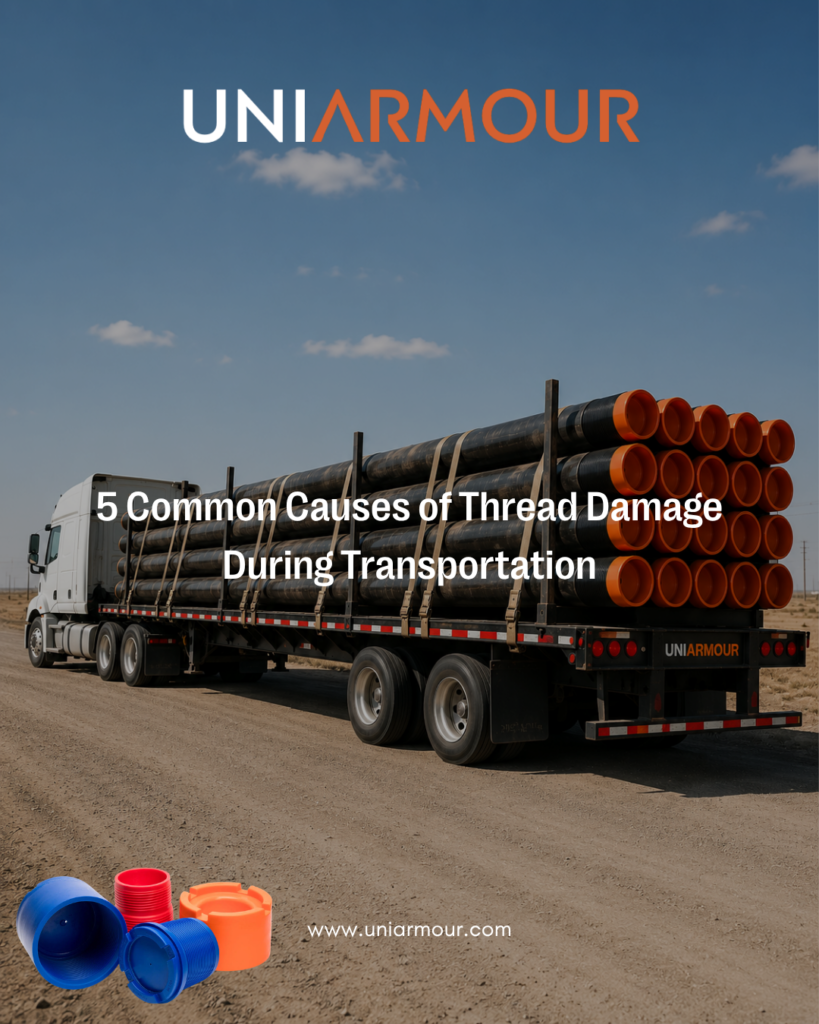
Image: OCTG pipes secured on a transport trailer with installed thread protectors.
Prevention Is Always More Cost-Effective
Repairing damaged OCTG threads requires additional inspection, machining, or replacement, resulting in unnecessary costs and operational delays.
By implementing proper transportation procedures and selecting reliable thread protection solutions, operators can significantly reduce transportation-related damage while extending the service life of valuable equipment.
Protecting threaded connections is a simple investment that delivers long-term operational and financial benefits.
Protecting Assets from the Mill to Production
At UniArmour, we design and manufacture innovative thread protection technologies that help customers protect their OCTG assets throughout the entire supply chain.
From standard API connections to specialized tubing and sucker rod applications, our products are engineered to deliver durability, secure fit, and reliable performance under demanding oilfield conditions.
Our thread protection solutions help operators:
- Reduce transportation damage.
- Protect precision-machined threads.
- Improve operational efficiency.
- Reduce maintenance costs.
- Increase equipment reliability.
- Support safer handling practices.
Protect your assets—from the mill to production.
Conclusion
Thread damage during transportation rarely occurs by accident. In most cases, it results from preventable handling, storage, or transportation issues.
Understanding the common causes of thread damage and implementing proper protection measures allows operators to reduce downtime, improve safety, and maximize the performance of their OCTG equipment.
With the right handling procedures and high-performance thread protection solutions, your threaded connections will arrive at the wellsite in optimal condition—ready for reliable performance when it matters most.
Because protecting your assets begins long before production starts.